Agentic Course Engineering
Co-developing education with AI
Over the past months, I have been working intensively with AI agents on the design and development of my courses at TU Delft. What began as support for producing course materials has developed into a broader approach that I call Agentic Course Engineering. ACE is the long-term co-development of a course by teachers and specialised AI agents, supported by software-engineering infrastructure for version control, automated review, and traceable change. In my current setup, these agents run on frontier systems including Claude Opus 4.x, the GPT-5 family, OpenAI Codex, and Google's Gemini 3.
I use "engineering" deliberately: ACE treats course development as systematic, versioned, reviewable, testable, and maintainable work.
In ACE, teachers and AI agents work together on the course as an evolving educational system. Lectures, exercises, workshop materials, assignments, exams, websites, datasets, and textbook chapters can be ideated, drafted, reviewed, tested, revised, aligned, and maintained over time.
This has become possible only recently. Current frontier systems can now work across many steps, use tools, inspect and edit files, run checks, hold large project contexts, and sustain collaboration over long sessions. This changes what AI can contribute to education. It can now support the longer, harder work of developing and improving a course across weeks and months.
Many courses are built under severe time pressure, often by small teams or individual teachers. Materials are scattered across slides, documents, learning platforms, spreadsheets, code, readings, exercises, and assessment files. Learning objectives, lectures, workshops, assignments, exams, and feedback often evolve at different speeds. ACE offers a way to make this work more coherent, more systematic, and easier to improve across iterations. The underlying educational promise is better course quality: stronger alignment, more consistent materials, and more deliberate improvement over time.
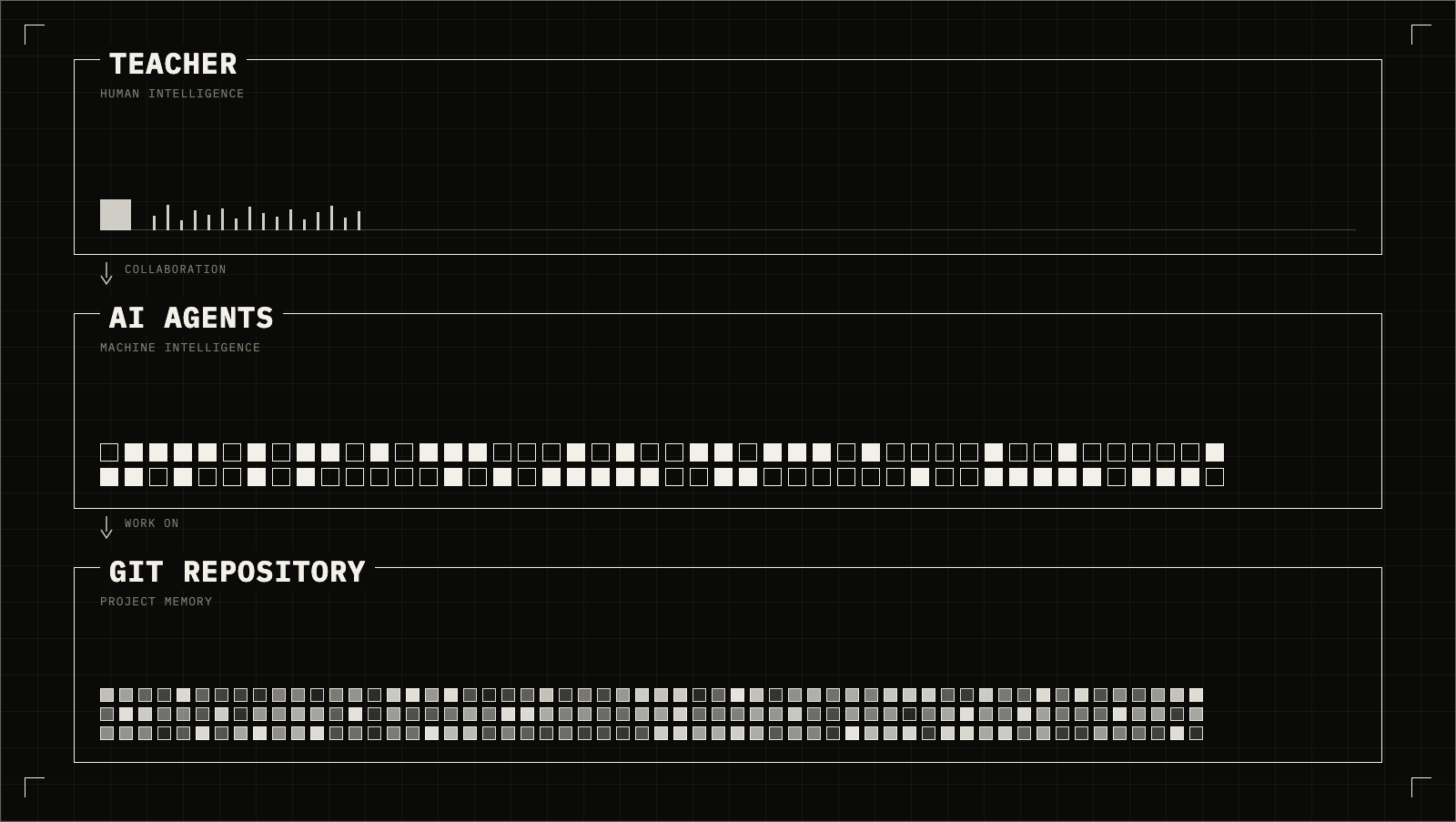
Teacher, human intelligence. Strategic decisions and responsibility, lived domain expertise, understanding of students, emotional intelligence, delegation and judgement.
AI agents, machine intelligence. Educational knowledge and didactics, the analyse-ideate-develop-evaluate cycle, reasoning over long context, long-horizon project memory, multi-agent collaboration.
Git repository, project memory and infrastructure. Version control, branches and merges, full traceability, build and deployment pipeline.
Agentic Course Engineering in practice
ACE has three layers: the human layer, the agentic AI layer, and the infrastructure layer. The human layer provides educational responsibility: judgment about what students should learn, what counts as good work, where difficulty should sit, how assessment evidence should be interpreted, and how teaching should respond to students. The agentic AI layer consists of specialised agents that work with different parts of the course. One agent may focus on didactic quality, another on assessment, another on exercises, textbook consistency, technical infrastructure, deployment, or documentation. The infrastructure layer keeps the work durable: files are versioned, changes are recorded, and materials can be reviewed, compared, revised, and deployed.
The collaboration develops through repeated engagement with the same course materials. Teachers and AI agents gradually build shared course knowledge: how learning objectives are phrased and used, how key concepts are introduced, where exercises fit, how assessment questions are written, and where students are likely to struggle. A didactics agent can follow learning-outcome alignment across lectures, exercises, and assignments. A content-quality agent can track terminology, examples, and explanations across the textbook and teaching materials. An assessment agent can build reusable knowledge about question types, difficulty, ambiguity, and coverage. This expertise is local, cumulative, and tied to the course itself.
The software-engineering infrastructure gives this collaboration continuity, control, and accountability. Agents work with files in a shared repository. Changes are tracked, compared, reviewed, reverted, and deployed. Course materials become modular components that can be inspected and improved while retaining their relation to the whole. The parallel with software development is useful here: complex educational systems also benefit from structure, versioning, testing, documentation, and maintenance.
Benefits for educators and course quality
ACE brings together educational judgment, course-specific knowledge, and agentic AI expertise. Teachers contribute responsibility for what students learn and what reaches the classroom. Specialised agents contribute persistent attention to didactics, content, assessment, and infrastructure. The combination can support more tailored course design, quicker iteration, and stronger consistency between learning objectives, course materials, and assessment.
For course quality, the most immediate opportunity is alignment. A worksheet can be checked against learning objectives. A lecture can be compared with the textbook. An assignment can be reviewed against the skills students have practised. Exam questions can be checked for coverage, difficulty, ambiguity, and consistency with the course language. Small inconsistencies that would normally remain hidden can become visible earlier.
A second opportunity is iteration. Courses often improve through experience, but the lessons from one run are easily lost. ACE makes it easier to turn teaching experience, student feedback, assessment results, and teacher reflection into concrete revisions. A course can be improved while it is being taught and then carried forward into the next edition with a clearer record of what changed and why.
A third opportunity is maintainability. University courses are rarely static. Readings change, technologies change, examples become outdated, assignments need adjustment, and assessment formats evolve. ACE can help keep the course coherent through these changes. The course becomes less dependent on memory, scattered files, and last-minute repair work, and more dependent on a maintained structure that teachers and AI agents can keep improving together.
The larger educational opportunity is more systematic course design at a level of detail that is difficult for one teacher or small team to sustain alone. More materials can be reviewed. More inconsistencies can be found. More alternatives can be explored. More feedback can be turned into revision. ACE could help educators create courses that are sharper, more coherent, better aligned, and more responsive to students.
Conclusion
ACE is still an emerging practice. Its value for student learning needs to be tested through teaching experience, student feedback, assessment results, and careful evaluation. Better materials and better alignment are promising conditions for better education, but they need to be studied in practice.
The contribution of ACE is to make course development more traceable, more reviewable, and more improvable through sustained human–AI collaboration. It gives educators a way to work on courses over days, weeks, and months with greater continuity and stronger technical discipline. The goal is better education: courses that are more coherent, more carefully developed, and easier to improve over time.